
'Serving the Area' Tells ChatGPT Nothing
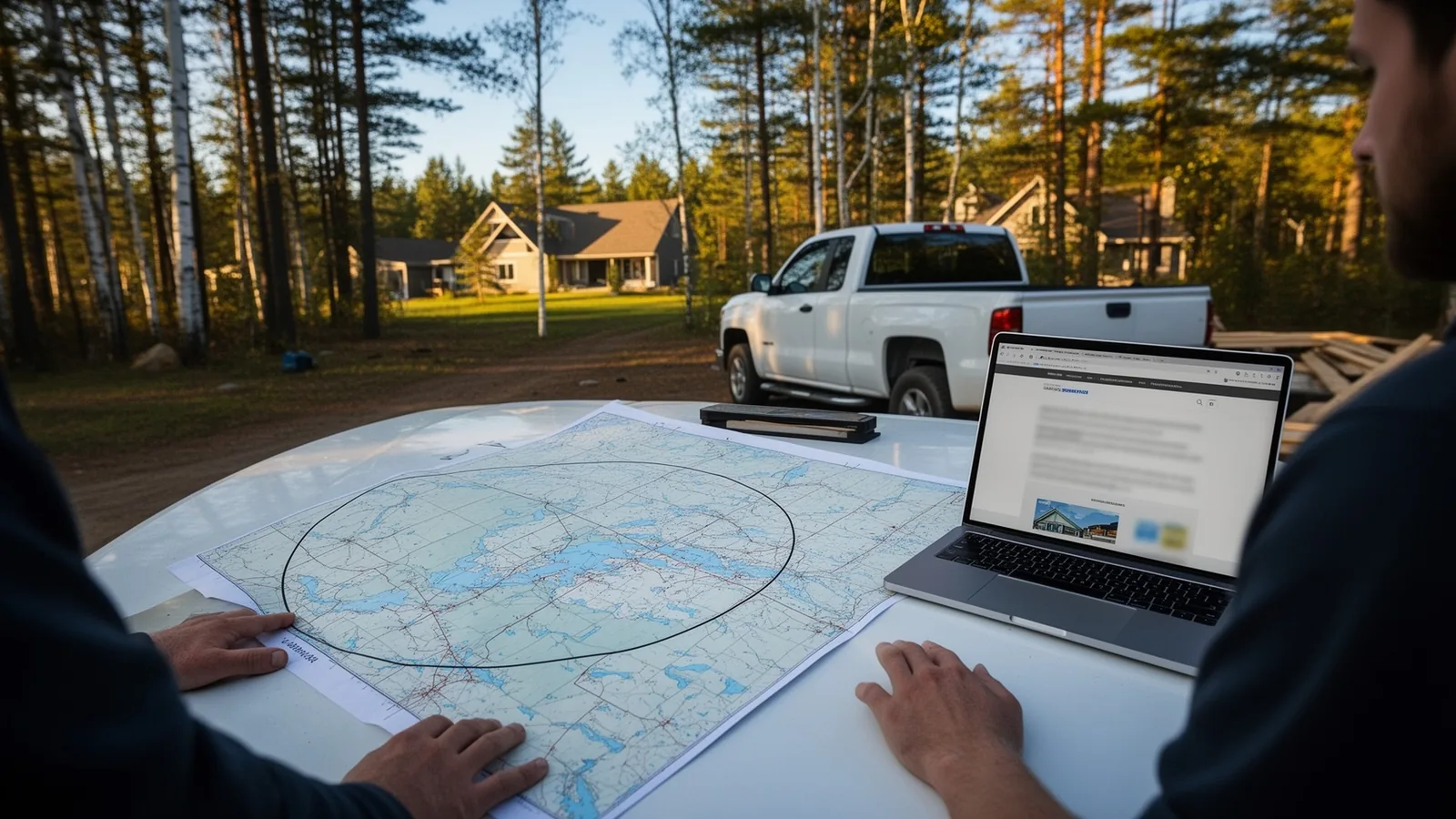
Scroll to the bottom of most contractor websites and you'll find it: "Proudly serving the greater area." Sometimes it's "the metro and surrounding communities." Sometimes it's a map with a circle on it.
A homeowner who lives ten minutes away might guess that means them. ChatGPT can't guess. When somebody asks it for a plumber in a specific town, it needs a page that says, in words, that you work in that town. Here's how to tell it where you actually work, and how not to overdo it.
Which area?
"Proudly serving the greater area." Which area? Greater Brainerd? Greater Minneapolis? Greater Minnesota? To a person who already knows you, it's friendly. To ChatGPT, it's a sentence with no place in it.
That matters because of how ChatGPT handles a local question. OpenAI says that when someone asks for something "near me," ChatGPT may estimate their general location from their IP address and rewrite the question into a search with a city in it. Its own example turns "good restaurants near me" into "top restaurants San Francisco" (OpenAI Help Center).
So a homeowner in Baxter who asks for "a roofer near me" may set off a search for something like "roofer Baxter MN." If no page on your site says Baxter, you've given that search nothing to find.
Name your towns, right on the page
Name your towns. Right there on the page, in plain text. Not inside a map image, not in a graphic, not only in a drop-down menu.
Here's where they belong:
- Your homepage. One plain sentence: "We fix furnaces and boilers in Brainerd, Baxter, Nisswa and the towns around them." Then the full list somewhere on the page, even if it's the footer.
- Your contact page. The towns you serve, plus your phone number as text.
- Your Google Business Profile. Google lets service-area businesses list up to 20 service areas by city or postal code, and suggests keeping them within about two hours' drive of your base (Google Business Profile Help). Use the same towns there that you name on your site.
- The code behind your page. The structured data that describes your business (a few lines of code machines read directly) has a property called areaServed for exactly this (schema.org). List your real towns there too, and keep it matched to the page. Google's rule is "don't mark up content that is not visible to readers of the page" (Google Search Central).
Name the towns you actually want work in, and actually drive to. If you won't go to a town, don't list it.
A page for every town only works if every page is real
A page for every town only works if every page is real. A lot of contractors hear "name your towns" and build thirty town pages from one template: same paragraphs, with the town name swapped. That's the version that can hurt you.
Google's spam rules describe "doorway abuse" and give as an example "having multiple domain names or pages targeted at specific regions or cities that funnel users to one page" (Google Search Central). The same rules warn against "creating substantially similar pages."
We learned this on my own company's site. Silver Loon Roofing had 56 town-and-service pages, things like roof repair in one town and roof repair in the next, and when we audited the site in October 2026 they were almost entirely the same words. On October 8 we cut all 56 and sent each one to its town page. We kept the 14 town pages and made each one genuinely local, with its own common questions from homeowners in that town.
What makes a town page real
A real town page tells a homeowner in that town something they couldn't read on the page for the next town over. A few things that do it (examples of what to write, not claims about any one town):
- The kind of work you do there. Lake cabins, older farmhouses, new subdivisions, rentals.
- Local conditions. Shade and lichen on a lake lot, hard water, clay soil, the wind off the open fields.
- How far you are. "About 15 miles from our shop" is useful and honest.
- Real local questions, answered in two or three sentences each.
- Real jobs, if you've done them there, described honestly, with your own photos.
If you can't write that for a town, you probably don't need a separate page for it. List it with the others on your service-area page and move on.
How many towns, and which ones?
Start with where the work actually comes from. Look at your last year of jobs. Which towns keep showing up? Those get named first, and if there's enough real local work, a page of their own. Smaller towns you serve go on one service-area page as a list, with a sentence about each if you can.
Then check your Google Business Profile matches. Same towns, same order of importance. When your website, your profile and your directory listings all say the same towns, the story about where you work is clear.
None of this guarantees ChatGPT will name you for any town. Nobody can promise that. But a business that never says where it works gives ChatGPT nothing to go on.
If you'd like to see how readable your homepage is today, the free audit at www.peakgrowthpartner.com/audit runs our five-part check in a few seconds. Type in your web address. That's all it asks for.
Sources
- OpenAI Help Center, "Searching the web with ChatGPT" (location and rewritten local searches): https://help.openai.com/en/articles/9237897-searching-the-web-with-chatgpt
- Google Business Profile Help, "Manage your service areas for service-area & hybrid businesses": https://support.google.com/business/answer/9157481
- schema.org, areaServed: https://schema.org/areaServed
- Google Search Central, "General structured data guidelines": https://developers.google.com/search/docs/appearance/structured-data/sd-policies
- Google Search Central, "Spam policies for Google web search" (doorway abuse): https://developers.google.com/search/docs/essentials/spam-policies