
Google still works. Here's what ChatGPT sees instead.
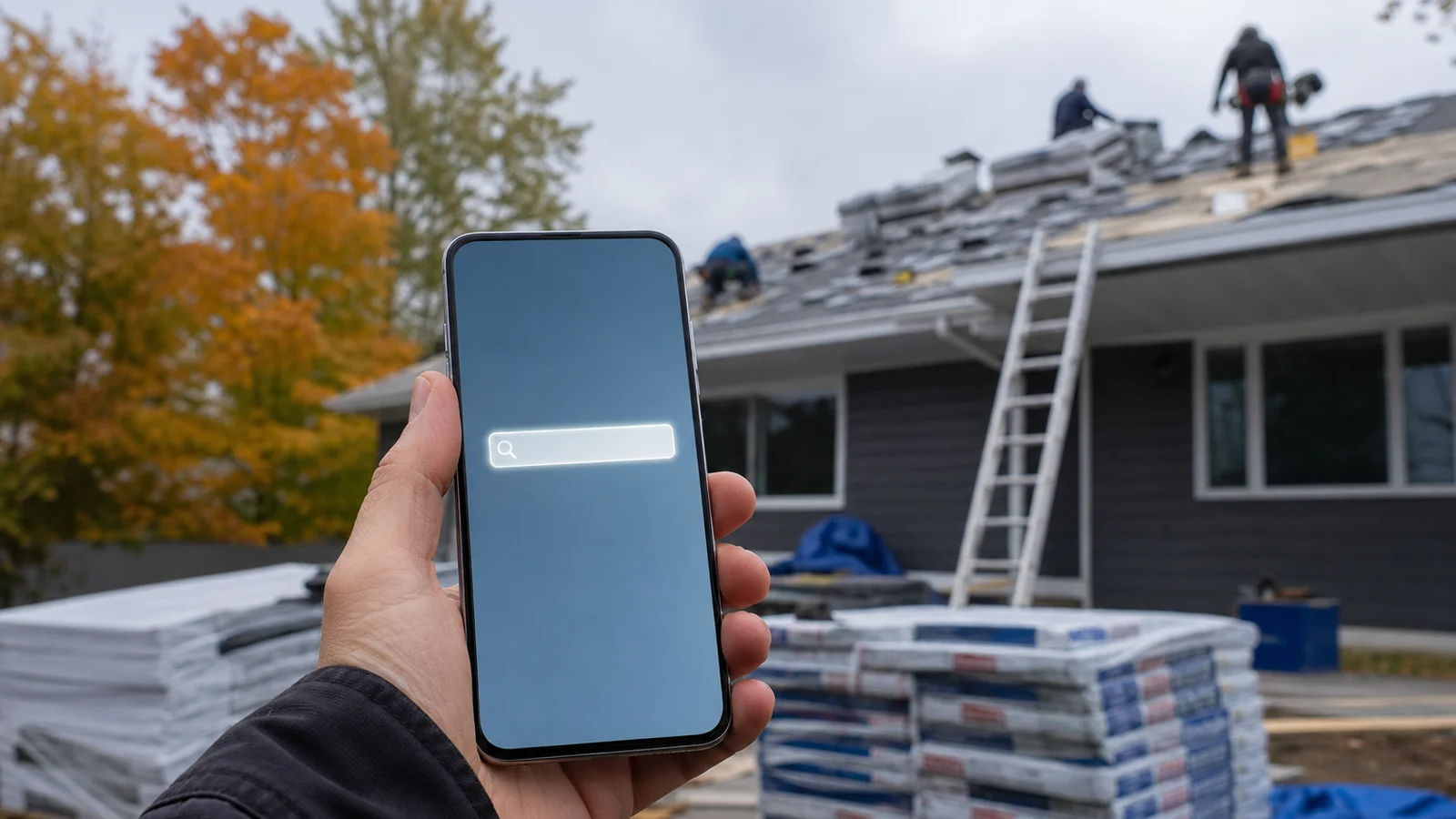
Late on a Friday afternoon, a homeowner in Eagan notices a brown ring spreading across the kitchen ceiling. She does what she has always done and searches Google for a roofer. She gets ads, a map, and a page of links, and she picks one. Then, because it's a big decision, she opens ChatGPT and asks the same question in plain words. This time there is no page. There is a short answer with a few company names in it.
Both of those searches are real. The mistake we see contractors make is hearing "AI search" and deciding Google is finished, or hearing "Google still works" and deciding nothing has changed. Neither is right. Here is what each one sees when it looks at your website, and why you want to be readable to both.
Two readers, one website
Your website is one set of pages, and two very different readers are looking at it.
Google has built an enormous index of pages. When someone searches, it hands back a list, ordered by how well each page seems to fit. A list is forgiving. You can sit in fifth place and still get the call, because people scroll, compare, and click more than one.
ChatGPT's search reads pages for a different reason: to write an answer. An answer is short by design. It has room for a few names, and for each name it has to say something true. So the question it is working on is not "which pages fit these words best?" It is "which businesses can I name, and what can I say about them?"
Same site. Same photos. Same phone number. Two different questions.
What each one rewards
This is a simplification, but it is a useful one:
- Google's list rewards pages that match what people type, that Google has indexed, and that load and work properly on a phone. It is a contest between pages.
- ChatGPT's answer rewards facts it can read plainly and repeat: your business name, what you do, where you work, how to reach you, and direct answers to the questions customers ask. In text, on the page.
- Both need the door open. If a crawler can't get in, nothing else matters.
On that last point, you don't have to take our word for it. OpenAI says that sites blocking its search crawler, OAI-SearchBot, won't be shown in ChatGPT search answers (OpenAI crawler documentation). Google says a page must be indexed and eligible for a snippet in regular Search to appear in AI Overviews or AI Mode, and that you don't need special AI files or markup to get there (Google Search Central).
Put those side by side and you can see the pattern. Google's AI answers draw on pages that are already in regular Google Search, so the work you've done for Google still counts there. ChatGPT has its own crawler and its own door. Being good at one doesn't automatically open the other.
Why a site can rank and still never get named
We can't see inside either system, and nobody can promise how they will answer.
Ranking is relative. Your page only has to look better than the other pages competing for the same words. Naming is absolute. The system has to be able to state who you are from what it read, and it has to feel safe repeating it.
Here's a test. Read your own homepage as words only, with the photos and sliders off. Could a stranger who has never heard of you describe your company in one sentence? What you do, where you do it, and how to reach you? That one sentence is exactly what ChatGPT has to write. If your phone number lives only inside a banner image, or your services only appear in a rotating slideshow, a person sees them and a crawler reading the page may not. A site can be a fine contender for a Google search and still hand an answer engine nothing it can quote.
Try it yourself: the two-window test
- In one window, search Google for your trade and your town, the way a homeowner would. Note where you show up.
- In a second window, ask ChatGPT: "Who are the best [your trade] companies in [your town], and why?" Note which names come back.
- Ask Perplexity the same thing, and read Google's AI answer if one appears at the top of the results.
- Where the tools show their sources, look at which pages they point to.
- Write down which of four places you landed: named in both, Google only, AI only, or neither.
Answers shift with the wording and the day, so ask it two or three different ways before you decide anything.
What you can do this month, no purchase required
Everything below is free or close to it, and you or someone on your team can do it:
- Check the door. Open yourdomain.com/robots.txt in a browser. Make sure it isn't blocking OAI-SearchBot or shutting out everything.
- Check Google can see you. Search site:yourdomain.com on Google to see which of your pages are indexed. Google's free Search Console shows indexing problems.
- Say it in text. Put your business name, address, phone, services, and service area in plain words on your homepage, not only inside an image.
- Answer the phone questions. Write down the five questions you get most, and answer each in two or three plain sentences on your site.
- Match everywhere. Make your name, address, and phone number identical on your site, your Google Business Profile, and Facebook.
- Add LocalBusiness schema. Free generators exist. It is the paperwork the inspector reads, and it spells out your details for a machine.
- If you like, add an llms.txt file. It is a plain text guide to your site and costs nothing. But Google says its AI features don't need one, so treat it as an optional extra, not a ranking secret.
What fixed looks like, and how to see yours
Three client sites went through this on our own five-part AI-search readiness check (starting scores August 2026, re-checked October 10, 2026): Alpine Peak Roofing from 52 to 95 out of 100, Silver Loon Roofing from 74 to 97, and EcoGuard Insulation from 72 to 94. The work in each case was the same: say plainly what the business is, in a form both readers can use.
If you'd rather not guess, our free audit looks at exactly this. At peakgrowthpartner.com, type in your web address and in seconds you get a score out of 100 and five checks: whether AI tools can read your business details, whether you have an llms.txt guide, whether your answers are marked up so AI can quote them, whether your headings are laid out so AI can follow them, and page speed. No email, no card, no call. If you want it, a nine-page report with the fix code included comes by email. Pick your trade: builders, roofing, mechanical, or site work. Keep doing what works on Google. This is what you add on top.